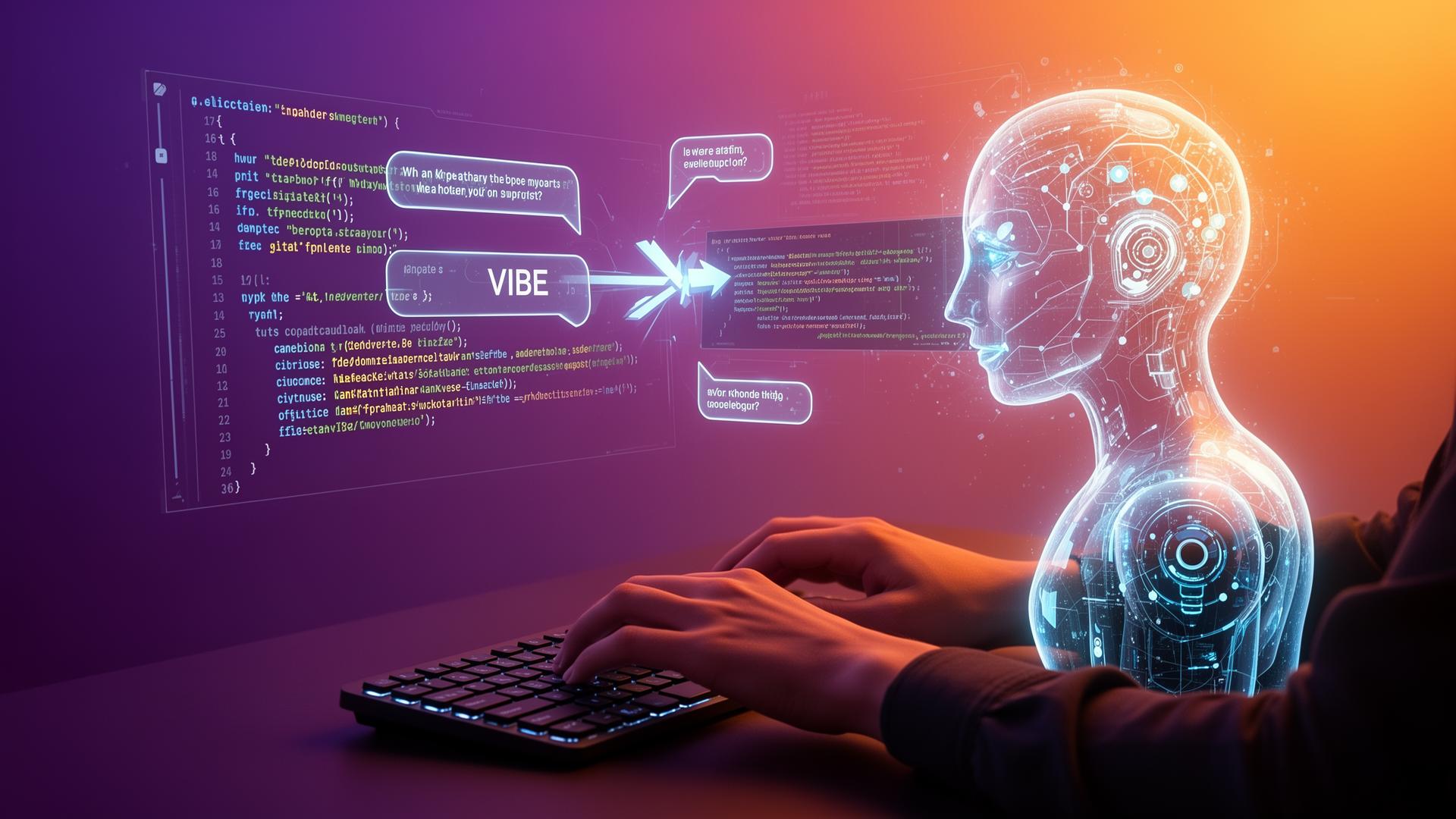
Vibe Coding: AI-Assisted Development Is Changing How We Build Software
A new development paradigm is emerging: 'vibe coding'—collaborating with AI to build software through natural conversation rather than line-by-line syntax. Here's what it means for developers and organizations.
What Is Vibe Coding?
Vibe coding describes a development style where human intent drives AI-generated code. Instead of writing every line manually, developers describe what they want in natural language, review AI-generated implementations, and iterate through conversation. It's not about replacing developers—it's about changing the nature of their work. The term captures something real: the shift from syntax-focused programming to intent-focused collaboration. Developers spend less time remembering API signatures and more time thinking about architecture, user experience, and business logic. The AI handles the boilerplate; humans handle the judgment.
The Productivity Reality
Early data suggests significant productivity gains—often 30-50% faster development for certain task categories. But the gains aren't uniform. Vibe coding excels at: generating boilerplate code, implementing well-understood patterns, writing tests for existing code, and creating documentation. It struggles with: novel architecture decisions, debugging subtle issues, understanding complex business context, and maintaining consistency across large codebases. Smart teams are learning to recognize which tasks benefit from AI assistance and which require pure human attention. The productivity gains come from optimal task allocation, not from blindly generating everything.
The Skills Shift
Vibe coding doesn't eliminate the need for programming skills—it transforms them. Reading code becomes more important than writing it, since you're reviewing AI-generated implementations. System design skills become critical, since AI can generate components but struggles with overall architecture. Debugging skills remain essential—AI-generated code fails in surprising ways, and understanding why requires deep technical knowledge. The developers thriving in this environment are those who can think at multiple abstraction levels: high enough to guide AI effectively, low enough to catch its mistakes.
Organizational Implications
For organizations, vibe coding creates both opportunities and challenges. On the opportunity side: faster prototyping, lower barriers for non-developers to contribute to codebases, and accelerated onboarding for new team members. On the challenge side: quality control becomes harder when code is generated rather than written. Security vulnerabilities can slip in when reviewers don't fully understand generated code. Technical debt accumulates faster when generating code is cheaper than maintaining it. Successful adoption requires updated code review practices, security scanning for AI-generated code, and explicit attention to architectural consistency.
Getting Started Responsibly
For teams exploring vibe coding, start with contained projects where you can learn the patterns without high-stakes risk. Use AI assistance for test coverage—it's low-risk and immediately valuable. Gradually expand to feature development once you've built intuition for when to trust AI output. Establish clear guidelines: always review generated code, never deploy without understanding, treat AI as a junior developer who needs supervision. The goal is augmented capability, not abdicated responsibility.
Conclusion
Vibe coding represents a genuine shift in software development—not a replacement for developers, but a transformation in how development happens. The developers and organizations who master this collaboration will build faster and smarter. Those who dismiss it will find themselves competing against teams with significant productivity advantages.
Keep reading
I Broke All Our AI Agents for Two Weeks. Here's What We Built Back.
Since late January, my team and I have been building AI agents that are transforming how we operate at Codistry. Six agents, each with a role, a personality, and access to our real systems. Then I pushed an update that broke all of them for two weeks.
OpenClaw: The Open-Source AI Agent Framework Changing the Game
OpenClaw is emerging as a powerful open-source framework for building AI agents. Here's why developers and enterprises are paying attention, and how it compares to proprietary alternatives.
Data Science in 2026: From Analysis to Automated Intelligence
The data science landscape has fundamentally shifted. Machine learning pipelines that took months now deploy in days. Here's what's changed, what still matters, and how to stay ahead.